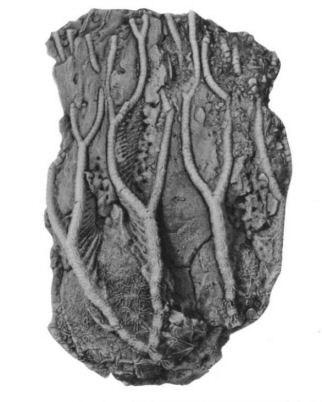
Gaurocrinus nealli
Nexocrinus parvus
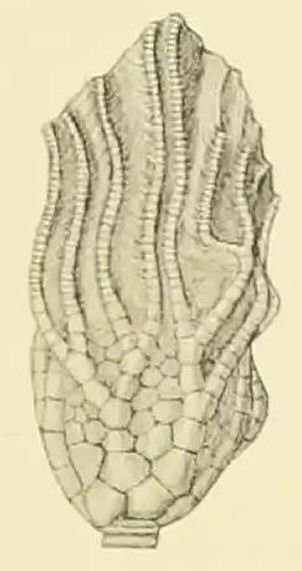
Pararchaeocrinus decoratus
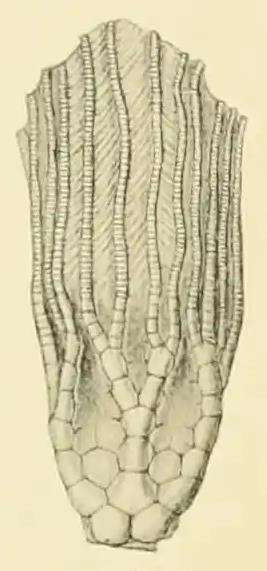
Rhaphanocrinus sculptus
Gaurocrinus nealli ![]() 10 mm scale Photos by Jack Kallmeyer |
The cup of G. nealli has very prominent
ray ridges that branch once on the
calyx and at least one more time
above it. The anal series is a raised ridge along the side of the
calyx. Gaurocrinus is a diplobathrid camerate
crinoid meaning that the cup is composed of three levels of plates. The
calyx plates between the raised ridges are small and irregularly shaped.
The arms are pinnulate. The
tegmen which covers the top of the
calyx is
comprised of many small plates with a small, narrow, dome-shaped
anal
sac. The stems are pentagonal in shape and vary in diameter depending upon position. See stem descriptions for details. Gaurocrinus used a distally coiled stem type of holdfast. Gaurocrinus can be found in the upper Waynesville (Blanchester Member) and lower Liberty Formations.
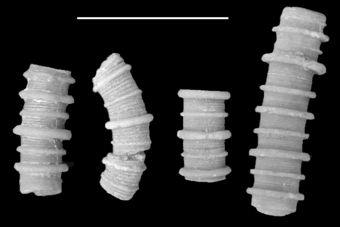
![]() ![]() Gaurocrinus Stems 10 mm scale Photo and Artwork by Jack Kallmeyer Stem is pentagonal with very rounded corners. On some columnals the corners project more than in this drawing but remain rounded. The articulating ridges are always perpendicular to the sides of the pentagon. The central opening is rounded pentagonal. |
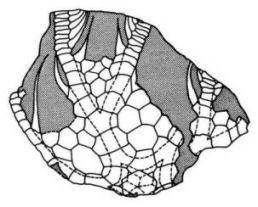
Nexocrinus parvus![]() ![]() The drawn figures of both sides of the calyx of Nexocrinus parvus are from Wachsmuth and Springer’s 1898 The North American Crinoidea Camerata. ![]() Photo from Steve Holland’s stratigrafia.org website. |
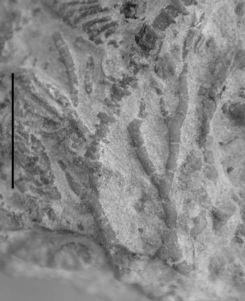
Nexocrinus parvus is a species that has gone by many names over the years, originally going by Glyptocrinus parvus (Hall), and then Reteocrinus gracilis (Wetherby), to Ptychocrinus parvus (Wachsmuth and Springer), before finally settling on Nexocrinus parvus (Eckert). This profusion of names for N. parvus is largely due to how old this species is and the better understanding of the different genera of camerates since its original description. Nexocrinus is a diplobathrid which means the base of the calyx contains three sets of interlocking plates. Nexocrinus has 20 arms which do not branch above the calyx. The calyx is conical and the plates have stellate ornamentation. In addition to the stellate ornamentation, Nexocrinus also has pronounced median ray ridges. Nexocrinus is distinguished from Rhaphanocrinus in that all of the radial plates outside of the C and D rays are in contact, whereas they are separated in all rays of Raphanocrinus by interradial plates. Nexocrinus is distinguished from Gaurocrinus in having interbrachial plates that are larger and better defined than Gaurocrinus. ![]() Photo from Steve Holland’s stratigrafia.org website. 5 mm Scale The stem of Nexocrinus is heteromorphic and superficially resembles that of Glyptocrinus. While the holdfast of Cincinnatian Nexocrinus aren’t known, other members of its family, the Dimerocrinitidae, have distal coils similar to Glyptocrinus and Pycnocrinus. N. parvus occurs in the Fairmount Member of the Fairview Formation. |
Pararchaeocrinus decoratus![]() ![]() Photo and drawing from paper by Stuart M. Kelly and John K. Pope. |
Pararchaeocrinus decoratus is a rare crinoid known in the local Cincinnatian from a single specimen recovered from either the uppermost Waynesville or lower Liberty formation at Weisburg, Indiana. Pararchaeocrinus has a globular calyx with fine stellate to granular ornamentation. The arms of Pararchaeocrinus branch once within the calyx and multiple times above the calyx. Pararchaeocrinus is a diplobathrid camerate, meaning that there are three sets of interlocking plates below the serially stacked plates of the fixed arms. Similar to other camerates such as the diplobathrid Gaurocrinus, Pararchaeocrinus possesses median ray ridges. The stem is not preserved in the Indiana specimen. Pararchaeocrinus decoratus was originally described from the Bromide Formation of Oklahoma, and another species, Pararchaeocrinus kiddi is known from the Bobcaygeon Formation of Oklahoma. Pararchaeocrinus is most readily distinguished from Glyptocrinus and Pycnocrinus in having infrabasal plates and arms which branch multiple times above the calyx. It is discerned from Rhaphanocrinus by the nature of the calyx plate ornamentation and more globular calyx shape. Gaurocrinus is distinguished readily from Pararchaeocrinus in having depressed interrays. |
Rhaphanocrinus sculptus ![]() (#1) Note the two juvenile cups on the upper left side of the larger crinoid. 5 mm scale (#1), 10 mm scale (#2) Photos by Jack Kallmeyer ![]() 5 mm scale Photo by Jack Kallmeyer |
This ornate crinoid is rare. Miami University, the Field Museum and the Smithsonian seem to be the only institutions that have any at all and they only have five between them. These crinoids have been found in the upper Waynesville and lower Liberty Formations. Rhaphanocrinus was originally mis-classified as a Glyptocrinus (a monobathrid camerate) because it seemed to have only two levels of plates composing the cup. It was later re-described when the third level of plates (lowest) was found to be present but hidden by the basal plates above them. When you see this crinoid you will see how easy it is to make that error. The basal plates (the middle level) project out over the stem with spectacular ridges that hide the lower infrabasals. The most obvious features of R. sculptus are the very high narrow ray ridges that begin at the basal plates. These ridges stand out sharply away from the calyx as if they were knife blades. The plates between the ray ridges also have smaller ridges. The adult crowns do not have an anal ridge on the side of the calyx. The tegmen is composed of many tiny plates. The heavy ornamentation on the calyx is missing from the smallest individuals so that there is a gradation of ornamentation from the smallest to the largest individuals. The arms of Rhaphanocrinus are round and carry pinnules.
The external shape of the stem can be described as broadly pentalobate with the diameter varying with position along the stem. Columnals nearest to the cup are more circular as are the smallest diameter columnals. The articulating ridges are radially arranged in a narrow ring. The central opening is circular.
|
The Dry Dredgers and individual contributors reserve the
rights to all information, images, and content presented here. Permission to
reproduce in any fashion, must be requested in writing to admin@drydredgers.org.
www.drydredgers.org is designed and maintained by Bill Heimbrock.